
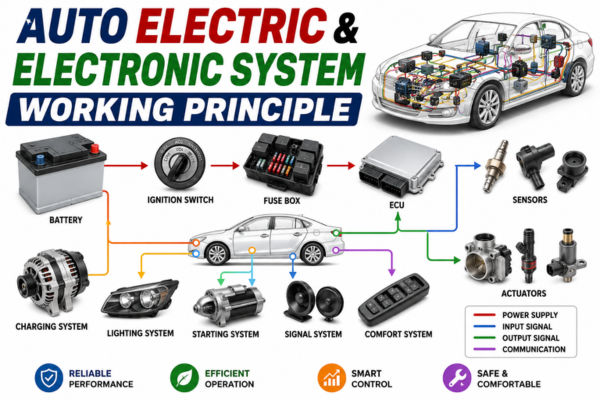
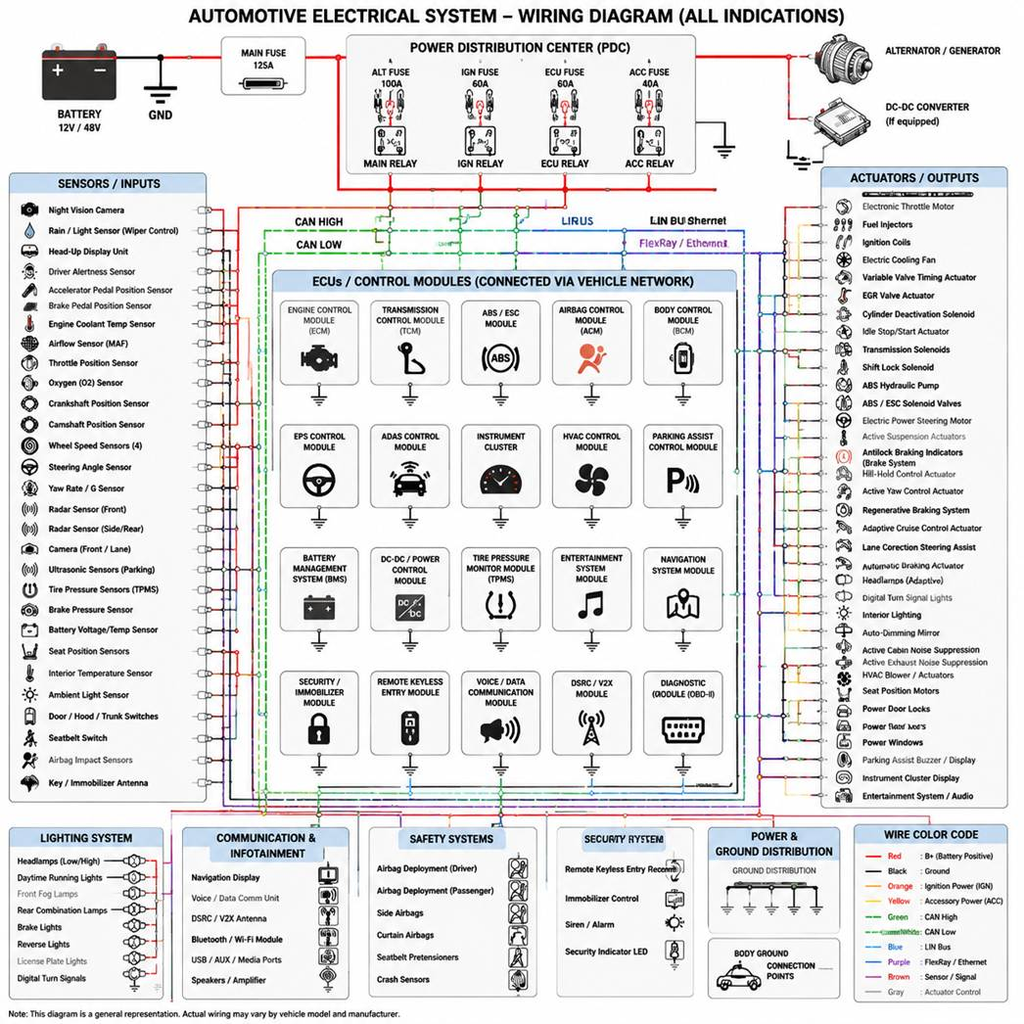
The Automotive electrical & Electronic system is the network of electrical and electronic components that supplies, controls, distributes, and uses electrical energy throughout a vehicle. The picture shows how modern vehicles integrate power supply, electronic control units (ECUs), sensors, actuators, communication networks, safety systems, driver-assistance systems, comfort systems, and infotainment.
1. Basic Automotive Electrical & Electronic System Working Principle
The overall electrical flow can be simplified as:
Battery → Power Distribution → ECU/Control Modules → Sensors → Processing → Actuators → Vehicle Function
At the same time:
Alternator/DC-DC Converter → Battery & Electrical Loads
Modern vehicles use multiple ECUs that communicate through networks such as CAN, LIN, FlexRay, and automotive Ethernet.
Simplified system

2. Battery and Power Supply
The battery is the primary electrical energy storage device when the engine is stopped.
It supplies power to systems such as:
- Engine ECU
- Instrument cluster
- Lighting
- Security system
- Audio/infotainment
- Electric power steering
- Airbag system
- Central locking
- Sensors and actuators
When the engine is running, the alternator in conventional vehicles generates electrical power and maintains the battery’s state of charge.
In hybrid and electric vehicles, the electrical architecture is more complex and may include:
- High-voltage battery
- DC-DC converter
- Inverter
- Battery management system (BMS)
- High-voltage control modules
3. Power Distribution for Automotive Electrical & Electronic System
Electrical energy from the battery is distributed through:
- Main fuse
- Fusible link
- Relays
- Junction boxes
- Power distribution modules
- Wiring harnesses
- Ground connections
The fuse protects a circuit from excessive current, while a relay lets a small control signal switch a larger electrical load.
For example:
Battery
│
▼
Fuse
│
▼
Relay
│
▼
ECU-controlled Load
│
▼
Motor / Lamp / Solenoid
│
▼
Ground
4. Sensors – The Vehicle’s “Eyes and Ears”
Modern vehicles continuously monitor operating conditions using sensors.
Examples include:
Engine sensors
- Crankshaft position sensor
- Camshaft position sensor
- Mass airflow sensor
- Manifold absolute pressure sensor
- Throttle position sensor
- Engine coolant temperature sensor
- Oxygen/A/F sensor
Safety and chassis sensors
- Wheel-speed sensors
- Steering-angle sensor
- Yaw-rate sensor
- Acceleration sensors
- Brake-pressure sensor
- Tire-pressure sensors
ADAS sensors
- Radar
- Camera
- Ultrasonic sensors
- LiDAR in some vehicles
The sensors convert physical conditions into electrical signals that ECUs can interpret.
5. Automotive Electrical & Electronic System Control Units (ECUs)
An ECU is essentially a specialized computer.
It receives information from sensors, processes the information according to programmed logic, and commands actuators.
For example:
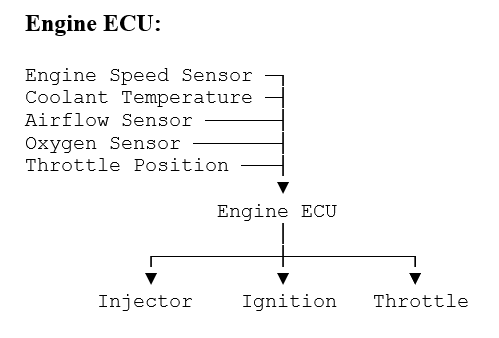
The ECU continuously repeats this process many times per second.
6. Actuators
Actuators convert electrical commands into physical action.
Examples include:
- Fuel injectors
- Electronic throttle motor
- Cooling fan
- EGR valve
- Variable valve timing actuator
- Turbocharger actuator
- ABS hydraulic modulator
- Electric power steering motor
- Door-lock actuator
- Headlamp actuator
- HVAC blower motor
For example, if the engine ECU determines that more fuel is required, it sends an electrical command to the fuel injector, which opens for a calculated period.
7. Communication Between ECUs
A modern automobile contains many control modules.
Examples:
- Engine Control Module (ECM)
- Transmission Control Module (TCM)
- ABS/ESC module
- Airbag Control Module
- Body Control Module (BCM)
- Electric Power Steering (EPS) module
- ADAS control module
- HVAC module
- Instrument cluster
- Infotainment system
Instead of giving every module a separate wire for every signal, they communicate through vehicle networks.

For example, the ABS module can provide vehicle-speed information to other ECUs through the CAN network.
8. Engine Control System
The Engine Control Unit controls numerous functions.
It receives information from sensors and calculates:
- Fuel injection quantity
- Injection timing
- Ignition timing
- Throttle opening
- Idle speed
- Variable valve timing
- EGR operation
- Cooling fan operation
- Emission-control functions
Working sequence
Sensor → ECU → Calculation → Actuator → Engine Response
For example:
Accelerator pedal pressed → Accelerator position detected → ECU calculates required torque → Electronic throttle opens → Engine airflow increases → Fuel quantity is adjusted → Engine torque increases.
9. Electronic Throttle Control
The picture identifies Electronic Throttle Control.
Unlike a traditional mechanical accelerator cable, an electronic throttle system uses:
- Accelerator pedal position sensors
- Engine ECU
- Throttle actuator motor
- Throttle position sensors
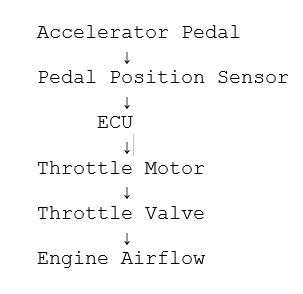
The ECU also uses feedback from the throttle-position sensor to confirm that the commanded position has been achieved.
10. Automotive Electrical & Electronic System for Power Steering
Electric Power Steering (EPS) uses an electric motor to assist steering.
The EPS controller receives information such as:
- Steering torque
- Steering angle
- Vehicle speed
- Motor position
The controller then operates the electric motor to provide appropriate steering assistance.
At low speed, greater assistance may be provided, while at higher speed the assistance can be reduced for better steering feel and stability.
11. ABS, ESC and Braking Electronics
The picture includes:
- Anti-lock Braking
- Electronic Stability Control
- Active Yaw Control
- Regenerative Braking
ABS working principle
Wheel-speed sensors monitor individual wheel speeds.
If the system detects that a wheel is about to lock during braking:
Wheel-speed sensor → ABS ECU → Hydraulic modulator → Brake pressure adjustment
The system rapidly adjusts brake pressure so the wheel can continue rotating and maintain steering control.
ESC
Electronic Stability Control compares vehicle movement with the driver’s intended direction.
It can selectively apply individual brakes and/or request engine torque reduction to help stabilize the vehicle.
12. Adaptive Cruise Control
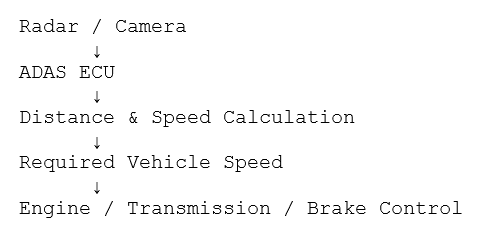
Adaptive Cruise Control (ACC) uses sensors such as radar and/or cameras to detect vehicles ahead.
The system can:
- Detect the vehicle ahead.
- Calculate distance.
- Determine relative speed.
- Adjust engine/brake torque.
- Maintain a selected following distance.
13. Lane Departure Warning and Lane Correction
Cameras can monitor road markings.
If the vehicle begins leaving its lane unintentionally, the system can:
- Provide a warning.
- Vibrate the steering wheel.
- Display an alert.
- Apply steering assistance in systems capable of lane correction.
This requires communication between the camera/ADAS system and steering or vehicle-control systems.
14. Blind-Spot Detection
Radar sensors or other sensing systems monitor areas beside and behind the vehicle.
When another vehicle enters the blind spot:
Radar → Blind-spot ECU → Warning signal → Door mirror/cluster warning
Some systems can provide additional steering or braking intervention depending on vehicle design.
15. Automotive Electrical & Electronic System for Airbag
The Supplemental Restraint System (SRS) uses an airbag control module and multiple sensors.
During a severe collision:
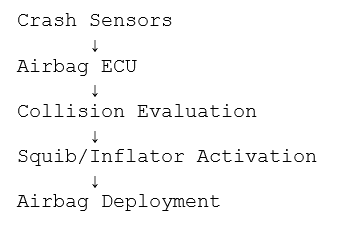
The system must distinguish between normal vehicle movement and crash events before deploying an airbag.
16. Instrument Cluster and Driver Information
The instrument cluster receives information from various ECUs.
It displays information such as:
- Vehicle speed
- Engine RPM
- Fuel level
- Coolant temperature
- Warning lamps
- ABS warning
- Engine warning
- Airbag warning
- Tire-pressure warning
- ADAS warnings
Much of this information can be transmitted through the vehicle communication network.
17. Automotive Electrical & Electronic System for Lighting System
Modern vehicles can have electronically controlled:
- Headlamps
- Adaptive front lighting
- Automatic high beam
- Daytime running lights
- Turn signals
- Brake lights
- Interior lighting
- Ambient lighting
The Body Control Module (BCM) may control many lighting functions based on inputs from switches, sensors, and other ECUs.
18. Body Control System
The BCM is responsible for many body-electrical functions, including:
- Central locking
- Power windows
- Wipers
- Interior lighting
- Exterior lighting
- Horn
- Keyless entry
- Security functions
- Remote functions
For example:
Rain sensor detects water → BCM receives signal → Wiper motor is commanded → Wipers operate automatically.
19. Parking Assistance
The parking system may use:
- Ultrasonic sensors
- Cameras
- Radar
- Parking ECU
The sensors detect nearby objects, and the system provides:
- Audible warnings
- Visual distance indications
- Surround-view images
- Automatic steering in vehicles equipped with automated parking
20. Tire Pressure Monitoring System (TPMS)
TPMS monitors tire pressure and sometimes tire temperature.
When pressure becomes too low:
Tire sensor → TPMS receiver/ECU → CAN network → Instrument cluster → Warning
The driver receives a low-pressure warning.
21. Battery Management
The picture includes Battery Management.
A battery management system monitors parameters such as:
- Battery voltage
- Current
- Temperature
- State of charge (SOC)
- State of health (SOH)
In hybrid and EV systems, BMS functions are particularly important because the battery operates at high voltage and stores significant energy.
22. Infotainment and Communication
Modern vehicles may integrate:
- Touchscreen display
- Audio system
- Bluetooth
- Smartphone connectivity
- Navigation
- Voice control
- Internet/data communication
- Emergency communication
The infotainment system communicates with other vehicle modules through the vehicle network while remaining separated from critical safety functions through appropriate network architecture and cybersecurity controls.
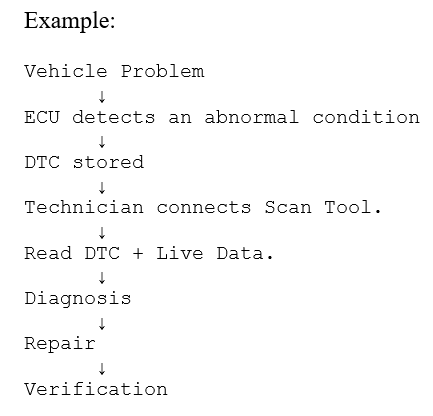
23. OBD-II Diagnostic System
The picture also identifies OBD-II.
The diagnostic system allows a technician to communicate with vehicle control modules using a diagnostic scan tool.
A technician can retrieve:
- Diagnostic Trouble Codes (DTCs)
- Live data
- Freeze-frame data
- Sensor values
- ECU information
- Readiness status
- Some actuator-test functions
24. Active Suspension
An electronically controlled suspension system can monitor:
- Vehicle speed
- Body movement
- Steering input
- Acceleration
- Road conditions
The controller adjusts suspension characteristics to improve:
- Ride comfort
- Handling
- Stability
- Body control
25. Regenerative Braking
Hybrid and electric vehicles can use the traction motor as a generator during deceleration.
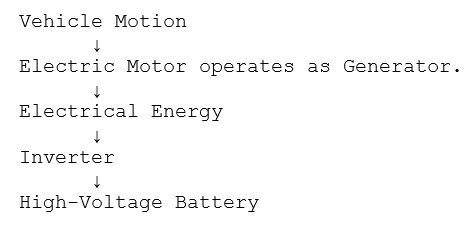
Instead of converting all kinetic energy into heat through conventional friction brakes, part of the energy can be recovered and stored in the battery.
26. Remote Keyless Entry and Security
The vehicle security system can communicate with:
- Smart key
- Immobilizer
- Body Control Module
- Door-lock system
- Engine ECU
A simplified sequence is:
Smart key authentication → BCM/security module verification → Door unlock authorization → Door actuator operates.
The immobilizer can also prevent engine operation if an authorized key is not detected.
27. The Complete Modern Automotive Electrical & Electronic System
The entire system can therefore be understood through five major stages:
Stage 1 — Energy
Battery / Alternator / DC-DC Converter
↓
Stage 2 — Distribution
Fuse / Relay / Junction Box / Wiring / Ground
↓
Stage 3 — Input
Sensors / Switches / Cameras / Radar
↓
Stage 4 — Decision
ECUs / Control Modules / CAN / LIN / Ethernet
↓
Stage 5 — Output
Motors / Solenoids / Lamps / Displays / Brakes / Steering / Injectors
Overall Working Principle
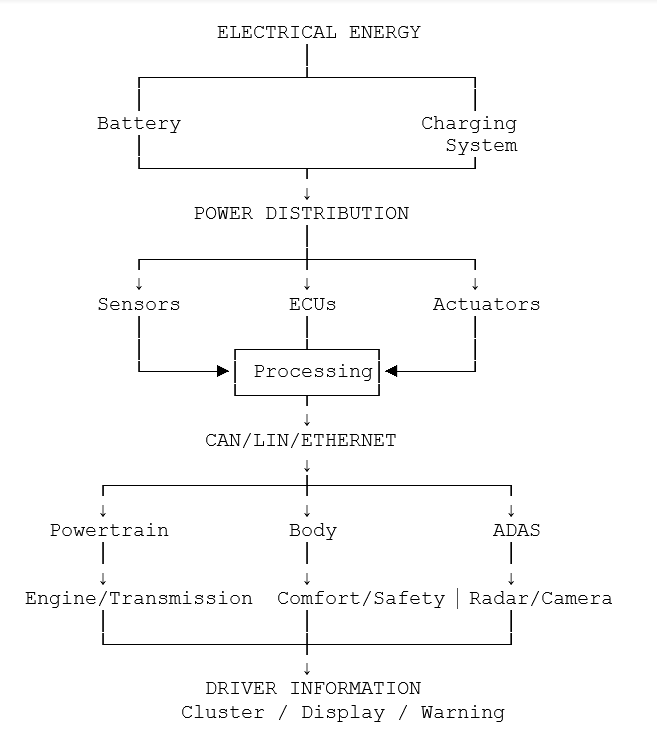
Automotive Electrical & Electronic System Wiring Diagram
Conclusion
The automotive electrical system works as a continuous feedback-control system:
Electrical power is supplied → sensors detect vehicle conditions → ECUs process the information → control modules communicate with each other → actuators perform the required action → sensors provide feedback → the ECU continuously corrects the operation.
This closed-loop principle underpins modern engine management, transmission control, ABS/ESC, EPS, ADAS, body electronics, hybrid systems, EV systems, infotainment, and vehicle diagnostics.