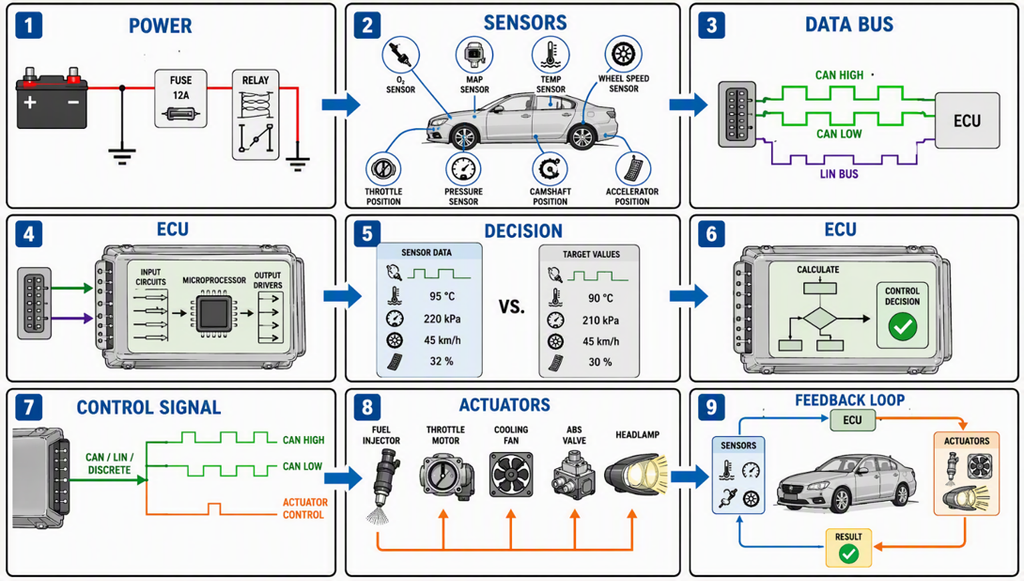
The Automotive Electrical & Electronic Systems Functions are explained as shown in the picture.
1. Driver, Safety & Information Systems
System shown in the picture
Brief function
Night Vision
Detects people, animals, or objects in low-light conditions and displays warnings to the driver.
Windshield Wiper Control
Automatically or manually controls wiper speed according to rain or driver input.
Head-Up Display (HUD)
Projects important driving information onto the windshield within the driver’s view.
Driver Alertness Monitoring
Monitors driver behavior and detects possible fatigue or loss of attention.
Event Data Recorder (EDR)
Records selected vehicle operating and crash-related data for analysis.
Accident Recorder
Records information surrounding an accident or severe impact event.
Instrument Cluster
Displays speed, RPM, fuel level, warnings, temperature, and other vehicle information.
Airbag Deployment
Activates appropriate airbags during a qualifying collision to protect occupants.
Parental Controls
Allows selected vehicle functions or driver settings to be restricted.
2. Engine & Powertrain of Automotive Electrical & Electronic Systems Functions
System shown in picture
Brief function
Engine Control
Controls engine operation using sensor inputs and ECU calculations.
Electronic Throttle Control
Electrically controls throttle opening instead of using a conventional mechanical cable.
Electronic Valve Timing
Adjusts valve timing to improve engine performance, fuel economy, and emissions.
Cylinder Deactivation
Temporarily shuts down selected cylinders under light load to save fuel.
Idle Stop/Start
Automatically stops the engine at suitable stops and restarts it when required.
Active Vibration Control
Reduces engine or drivetrain vibration using electronically controlled compensation.
Transmission Control
It controls automatic/CVT/DCT transmission operation & gear or ratio selection.
Battery Management
Monitors battery condition, charging, temperature, current, and state of charge.
Regenerative Braking
Recovers kinetic energy during deceleration and converts it into electrical energy in hybrid/EV systems.
3. Driver Assistance & Chassis Systems
System shown in picture
Brief function
Adaptive Front Lighting
Adjusts headlamp direction or beam pattern according to driving conditions.
Adaptive Cruise Control
Maintains a selected speed and adjusts it to maintain distance from vehicles ahead.
Automatic Braking
Automatically applies the brakes when a potential collision or other condition requires intervention.
Electric Power Steering
Uses an electric motor to provide steering assistance.
Blindspot Detection
Detects vehicles or objects in areas that may not be visible in the mirrors.
Lane Departure Warning
Warns the driver when the vehicle unintentionally moves out of its lane.
Lane Correction
Provides steering assistance to help keep the vehicle within its lane.
Electronic Stability Control (ESC)
Helps maintain vehicle stability by controlling engine torque and individual wheel braking.
Active Yaw Control
Controls vehicle yaw behavior to improve cornering stability and handling.
Antilock Braking (ABS)
Prevents wheel lock-up during hard braking and helps maintain steering control.
Hill-Hold Control
Temporarily maintains brake pressure to prevent the vehicle from rolling on an incline.
Parking System
Uses sensors/cameras to assist the driver when parking and detecting nearby obstacles.
Tire Pressure Monitoring (TPMS)
Monitors tire pressure & provides a warning to the driver when pressure is too low or abnormal.
Active Suspension
Electronically adjusts suspension behavior to improve ride comfort and handling.
4. Lighting, Mirror & Cabin Systems
System shown in picture
Brief function
Auto-Dimming Mirror
Automatically reduces mirror glare when bright light from vehicles behind is detected.
Interior Lighting
Provides illumination inside the passenger cabin and may be automatically controlled.
Cabin Environment Controls
Controls cabin temperature, airflow, ventilation and other comfort functions.
Active Cabin Noise Suppression
Uses electronic technology to reduce unwanted noise inside the cabin.
Active Exhaust Noise Suppression
Reduces or manages unwanted exhaust/drivetrain noise using active electronic control.
Seat Position Control
Electrically adjusts seat position and, in some vehicles, stores preferred positions.
5. Communication & Infotainment
System shown in picture
Brief function
Voice/Data Communications
Provides voice, data, and connected communication between the vehicle, occupants, and external services.
DSRC
Enables short-range wireless communication between vehicles and road infrastructure where supported.
Navigation System
Determines vehicle location and provides route guidance and map information.
Entertainment System
Provides audio, video, and other entertainment functions for occupants.
Digital Turn Signals
Provides electronically controlled turn-indicator signaling to communicate the driver’s intention.
Electronic Toll Collection
Enables electronic identification/payment of applicable road or toll charges.
6. Security & Access Systems
System shown in picture
Brief function
Remote Keyless Entry
Allows the driver to lock/unlock the vehicle remotely using a key fob or smart key.
Security System
Protects the vehicle against unauthorized entry, starting, or other security threats.
7. Diagnostic & Electronic Control Systems
System shown in the picture
Brief function
OBD-II
Provides standardized diagnostic access for reading fault codes and monitoring vehicle systems.
ECUs / Control Modules
Receive sensor information, process programmed logic, and control vehicle functions.
Vehicle Communication Network
Allows different ECUs and control modules to exchange information.
Note: The diagram specifically labels OBD-II, while the individual ECUs and communication network are represented through the various electronic functions shown around the vehicle.
The attached picture represents a modern vehicle as an integrated electrical and electronic system. The battery supplies electrical energy, sensors detect vehicle and environmental conditions, ECUs make decisions, communication networks exchange information, and actuators operate the engine, transmission, brakes, steering, lighting, safety, comfort, communication, and driver-assistance systems.