
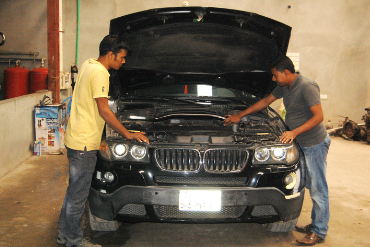
1. Course Information of Auto Mechanic
Course Title: Professional Auto Mechanic
Duration: 6 Months (24 Weeks)
Course Type:
- Classroom Theory: 30%
- Practical Workshop: 25%
- On-the-Job Training (OJT): 45%
Course Fee: ৳30,000/=
Total Training Hours: 720 Hours
- Classroom Theory: 200 Hours
- Practical Workshop: 160 Hours
- On-the-Job Training (OJT): 300 Hours
- Driving Skills (T+P+O): 20 Hours
- Computer and Digital Skills (T+P+O): 20 Hours
- English Communication Skills (T+P): 20 Hours
Training Level: Beginner to Professional Auto Mechanic
Target Group:
- Overseas Higher Study Students
- School Leavers
- Job Seekers
- Apprentice Mechanics
- Entry-Level Auto Mechanics
- Workshop Technicians
- Fleet Maintenance Personnel
- Automotive Enthusiasts
- Career Changers
- Entrepreneurs
- Overseas Employment Candidates
Entry Requirement:
- Minimum Class VIII/SSC (Preferred) & Above
- Basic Mathematics
- Physically fit for workshop activities
Job Opportunity (Home & Abroad):
- Government Organization
- Semi-Government Organization
- NGO
- Autonomous Organization
- Private Organization
- Corporate Organization
- Authorized automobile dealerships
- Independent automotive workshops
- Fleet maintenance companies
- Transport and logistics organizations
- Manufacturing industries
- Vehicle inspection and testing centers
- Automotive training institutes
- Automobile spare parts and service companies
- Self-employment/ Entrepreneurship
2. Course Objective
Upon completing this course, trainees will be able to:
- Diagnose vehicle faults systematically.
- Repair gasoline and diesel vehicles.
- Use modern diagnostic scanners.
- Read workshop manuals.
- Communicate with customers professionally.
- Able to fill out various usable check sheets
- Prepare an estimate based on the diagnosis
- Prepare job cards and service reports.
- Able to report assigned lineman
- Use computers for workshop management.
- Communicate in English in international workshops.
- Work safely according to the international standard.
- Become self-employed or work in local and overseas industries.
3. Training Modules
There are several training modules.
- Orientation
- Workshop safety
- Basic Mechanical Engineering
- 18 Automobile Systems
- Vehicle Diagnosis
- Advance Automobile Technology
- Driving Skills
- Computer and Digital Skills
- English Communication Skills
- Workshop Management & Entrepreneurship
4. Training Module Content Details
| Sl# | Content | Type | Duration | Docs | Video | |
| 1 | Orientation | Theory | 0.25 | |||
| 2 | Course Overview | Theory | 0.25 | |||
| 3 | History of Automobiles | Theory | 2 | |||
| 4 | Worldwide Automobile Makers | Theory | 2.5 | |||
| 5 | Workshop Safety | Theory | 0.5 | |||
| 6 | Workshop Safety | Practical | 2 | |||
| 7 | Perform First Aid Practice | Theory | 2 | |||
| 8 | Basic Mechanical Engineering | Theory | 1 | |||
| 9 | Basic Mechanical Engineering | Practical | 5 | |||
| 10 | 18 Automobile Systems | Theory | 5 | |||
| 11 | Engine System | Theory | 1 | |||
| 12 | Engine System | Practical | 2 | |||
| 13 | Engine System | OJT | 36 | |||
| 14 | Intake System | Theory | 1 | |||
| 15 | Intake System | Practical | 1 | |||
| 16 | Intake System | OJT | 24 | |||
| 17 | Fuel System | Theory | 1 | |||
| 18 | Fuel System | Practical | 1 | |||
| 19 | Fuel System | OJT | 36 | |||
| 20 | Ignition System | Theory | 1 | |||
| 21 | Ignition System | Practical | 1 | |||
| 22 | Ignition System | OJT | 18 | |||
| 23 | Exhaust System | Theory | 1 | |||
| 24 | Exhaust System | Practical | 1 | |||
| 25 | Exhaust System | OJT | 18 | |||
| 26 | Lubrication System | Theory | 1 | |||
| 27 | Lubrication System | Practical | 1 | |||
| 28 | Lubrication System | OJT | 18 | |||
| 29 | Cooling System | Theory | 1 | |||
| 30 | Cooling System | Practical | 1 | |||
| 31 | Cooling System | OJT | 24 | |||
| 32 | Clutch System | Theory | 1 | |||
| 33 | Clutch System | Practical | 1 | |||
| 34 | Clutch System | OJT | 24 | |||
| 35 | Transmission System | Theory | 1 | |||
| 36 | Transmission System | Practical | 1 | |||
| 37 | Transmission System | OJT | 35 | |||
| 38 | Suspension System | Theory | 1 | |||
| 39 | Suspension System | Practical | 1 | |||
| 40 | Suspension System | OJT | 43 | |||
| 41 | Steering System | Theory | 1 | |||
| 42 | Steering System | Practical | 1 | |||
| 43 | Steering System | OJT | 24 | |||
| 44 | Brake System | Theory | 1 | |||
| 45 | Brake System | Practical | 1 | |||
| 46 | Brake System | OJT | 40 | |||
| 47 | Starting System | Theory | 1 | |||
| 48 | Starting System | Practical | 1 | |||
| 49 | Starting System | OJT | 18 | |||
| 50 | Engine Electrical System | Theory | 1 | |||
| 51 | Engine Electrical System | Practical | 1 | |||
| 52 | Engine Electrical System | OJT | 24 | |||
| 53 | Body Electrical System | Theory | 1 | |||
| 54 | Body Electrical System | Practical | 1 | |||
| 55 | Body Electrical System | OJT | 24 | |||
| 56 | Charging System | Theory | 1 | |||
| 57 | Charging System | Practical | 1 | |||
| 58 | Charging System | OJT | 18 | |||
| 59 | AC System | Theory | 1 | |||
| 60 | AC System | Practical | 1 | |||
| 61 | AC System | OJT | 18 | |||
| 62 | Body | Theory | 0.5 | |||
| 63 | Vehicle Diagnosis | Practical | 8 | |||
| 64 | Vehicle Diagnosis | OJT | 18 | |||
| 65 | Vehicle Diagnosis | Theory | 36 | |||
| 66 | Advance Automobile Technology | Practical | 8 | |||
| 67 | Advance Automobile Technology | OJT | 18 | |||
| 68 | Advance Automobile Technology | Theory | 36 | |||
| 69 | What is the meaning of GLI, XLI? | Theory | 0.5 | |||
| 70 | Defensive driving principles | Theory | 1 | |||
| 71 | Defensive driving principles | Practical | 10 | |||
| 72 | 10 Principles of Safety Driving | Theory | 1 | |||
| 73 | 10 Principles of Safety Driving | Practical | 1 | |||
| 74 | Tools list during driving | Theory | 0.5 | |||
| 75 | Familiar with maintenance items | Theory | 1 | |||
| 76 | Various Warning Lights in the Dashboard | Theory | 1 | |||
| 77 | Various Warning Light in Dashboard | Practical | 2 | |||
| 78 | Familiar with road traffic signage | Theory | 1 | |||
| 79 | Factors affected fuel economy | Theory | 0.5 | |||
| 80 | Cause of vehicles catching fire | Theory | 0.5 | |||
| 81 | Be aware about distracted driving | Theory | 0.5 | |||
| 82 | Computer fundamentals | Theory | 1 | |||
| 83 | Microsoft Word | Theory | 3 | |||
| 84 | Microsoft Excel | Theory | 3 | |||
| 85 | PowerPoint | Theory | 3 | |||
| 86 | Email communication | Theory | 1 | |||
| 87 | Cloud storage | Theory | 0.5 | |||
| 88 | Internet research | Theory | 0.5 | |||
| 89 | Cybersecurity basics | Theory | 0.5 | |||
| 90 | Workshop management software | Theory | 1 | |||
| 91 | Digital customer records | Theory | 0.5 | |||
| 92 | Preparing job cards | Practical | 1 | |||
| 93 | Creating quotations | Practical | 1 | |||
| 94 | Writing service reports | Practical | 1 | |||
| 95 | Maintaining inventory | Practical | 1 | |||
| 96 | Online spare parts search | Practical | 1 | |||
| 97 | Accessing manufacturer service manuals | Practical | 0.5 | |||
| 98 | Using digital inspection checklists | Practical | 0.5 | |||
| Speaking | ||||||
| 99 | Greetings | Theory | 0.5 | |||
| 100 | Customer reception | Theory | 0.5 | |||
| 101 | Telephone communication | Theory | 0.5 | |||
| 102 | Appointment scheduling | Theory | 1 | |||
| 103 | Explaining repairs | Theory | 1 | |||
| 104 | Giving estimates | Theory | 1 | |||
| 105 | Handling complaints | Theory | 1 | |||
| 106 | 1000 Automotive English Vocabulary | Theory | 1 | |||
| 107 | 2000 Business Communication Words | Theory | 1.5 | |||
| 108 | 1000 Automotive Abbreviations | Theory | 1 | |||
| 109 | 500 professional conversation words | Theory | 1 | |||
| 110 | 300 Common English Phrases | Theory | 1 | |||
| 111 | 500 Daily Spoken English Q & A | Theory | 1 | |||
| Reading | ||||||
| 112 | Repair manuals | Theory | 0.5 | |||
| 113 | Wiring diagrams | Theory | 0.5 | |||
| 114 | Collision Damage Manual | Theory | 0.5 | |||
| 115 | Parts catalogues | Theory | 0.5 | |||
| 116 | Owner’s Manual | Theory | 0.5 | |||
| Writing | ||||||
| 119 | Service reports | Theory | 0.5 | |||
| 120 | Emails | Theory | 1 | |||
| 121 | Quotations | Theory | 1 | |||
| 122 | Job cards | Theory | 1 | |||
| 123 | Inspection reports | Theory | 0.5 | |||
| Listening | ||||||
| 124 | Customer conversations | Theory | 0.5 | |||
| 125 | Technical videos | Theory | 0.5 | |||
| 126 | International workshop communication | Theory | 0.5 | |||
| Workshop Management & Entrepreneurship | ||||||
| 127 | Opening an automobile workshop | Theory | 1 | |||
| 128 | Customer management | Theory | 1.5 | |||
| 129 | Inventory control | Theory | 0.5 | |||
| 130 | Spare parts management | Theory | 2 | |||
| 131 | Pricing strategy | Theory | 1 | |||
| 132 | Marketing | Theory | 1 | |||
| 133 | Social media promotion | Theory | 2 | |||
| 134 | Financial management | Theory | 0.5 | |||
| 135 | Tax basics | Theory | 0.5 | |||
| 136 | Business ethics | Theory | 0.5 | |||
| 137 | Service Menu | Theory | 5 | |||
| 138 | Periodic Maintenance Check Sheet | Theory | 2 | |||
| 139 | Diagnosis Check Sheet | Theory | 2 | |||
| 140 | Quality Control Check Sheet | Theory | 2 | |||
| 141 | 10 Principles of Auto Technician | Theory | 3 | |||
| 142 | Job Description of Auto Mechanic | Theory | 3 | |||
| 143 | 5S Methodology | Theory | 5.5 | |||
| 144 | KAIZEN | Theory | 3 | |||
| 145 | Office Manner | Theory | 1.5 | |||
| Total Hours | 720 | |||||
5. Assessment Scheme
- Theory Examination: 25%
- Practical Skills Test: 35%
- Attendance:5%
- Continuous Assessment: 5%
- Workshop Performance: 10%
- OJT Evaluation: 10%
- Driving Skills Assessment: 5%
- Computer Skills Assessment: 2.5%
- English Communication Assessment:2.5%
- Total: 100%
Note: A minimum overall score of 70% is recommended for certification.
6. Soft Skills Development
Throughout the course, trainees should develop the following soft skills:
- Communication and presentation skills
- Professional ethics
- Time management
- Teamwork
- Leadership
- Critical thinking
- Problem-solving
- Customer service excellence
- Quality assurance
- Workplace discipline
- Continuous learning mindset
- Adaptability to new automotive technologies
- Analytical troubleshooting
7. Required Training Resources
I. Workshop Resources. e.g.
- Vehicle lifts
- Engine stands
- Hydraulic jacks
- Air compressor
- OBD-II scanners
- Oscilloscope
- Digital multimeters
- Battery tester
- Wheel balancer
- Wheel alignment machine
- Brake lathe
- Injector cleaner
- Compression tester
- Torque wrenches
- Cooling system pressure tester
- Vacuum gauge
- Smoke leak detector
II. Computer Resources
- Desktop/laptop computers
- Dealer Management System (DMS)
- Enterprise Resource Planning (ERP) software
- Customer Relationship Management (CRM) software
- Microsoft Office
- Internet access
- Printers and scanners
III. Training Facilities
- · Multimedia classroom
- Projector and smart board
- Meeting room for role-play
- Library of workshop manuals
- Simulation lab for workflow planning
8. Graduate Competencies
Graduates who complete this curriculum will be able to:
- Diagnose, maintain, service, and repair gasoline- and diesel-powered passenger and light-commercial vehicles using systematic, manufacturer-recommended procedures.
- Perform inspections, preventive maintenance, component replacement, engine overhauls, brake servicing, steering and suspension repairs, transmission servicing, and basic electrical troubleshooting with confidence.
- Use modern workshop equipment, diagnostic scanners, multimeters, and technical service information to identify faults, verify repairs, and improve repair quality.
- Read and interpret workshop manuals, wiring diagrams, technical specifications, repair procedures, and electronic parts catalogs to support accurate and efficient maintenance.
- Plan and manage workshop activities by preparing job cards, estimating repair costs, coordinating spare parts, maintaining service records, and supporting quality assurance and customer satisfaction.
- Safely operate and road-test vehicles before and after repairs while applying defensive driving techniques, occupational health and safety practices, and environmental protection standards.
- Utilize computers, spreadsheets, workshop management software, and digital resources to create reports, manage inventory, communicate professionally, and access online technical information.
- Communicate effectively in English through customer interactions, technical discussions, written reports, emails, presentations, and collaboration with international employers and manufacturers.
- Demonstrate professionalism, teamwork, leadership, ethical conduct, and a commitment to continuous learning as you adapt to emerging automotive technologies, including hybrid and electric vehicles.
- Qualify for employment as an Auto Mechanic, Automotive Service Technician, Fleet Maintenance Technician, Workshop Technician, Field Service Technician, Maintenance Mechanic, Service Center Technician, Automotive Diagnostic Assistant, or progress toward advanced roles such as Auto Diagnosis Technician, Workshop Supervisor, or Technical Advisor through further training and industry experience.