

The hybrid vehicle brake system uses a combined braking system consisting of regenerative braking and conventional friction braking. The electronic brake-control system continuously determines how much braking torque should come from the electric motor and how much should come from the hydraulic/friction brakes.
1. Main Components of Hybrid Vehicle Brake System
- Brake Pedal and Pedal Sensor – Detects the driver’s braking request.
- Brake Control ECU – Calculates the required braking force and coordinates regenerative and friction braking.
- Electric Motor/Generator – Produces regenerative braking torque and electrical energy during deceleration.
- Inverter/Power Control Unit – Controls electrical power between the motor-generator and high-voltage battery.
- High-Voltage Battery – Stores electrical energy recovered during braking.
- Hydraulic Brake Actuator – Generates hydraulic pressure for the friction brakes.
- Brake Calipers & Disc/Drum Brakes – Provide mechanical braking force.
- ABS – Prevents wheel lock during hard braking.
- Wheel-Speed Sensors – Monitor individual wheel speeds.
- Hybrid Control Unit (HCU) – Coordinates the hybrid powertrain and braking strategy.
- Brake Booster – Provides the required brake-assist force; modern HEVs may use an electromechanical brake booster instead of a conventional vacuum booster.
- Yaw/Vehicle Stability Sensors – Help maintain vehicle stability during braking and cornering.
2. Basic Working Principle of Hybrid Vehicle Brake System
When the vehicle is moving, it has kinetic energy.
During conventional braking:
Kinetic Energy → Friction Brakes → Heat → Energy Lost
In regenerative braking:
Kinetic Energy → Electric Motor/Generator → Electrical Energy → HV Battery
The U.S. Department of Energy describes regenerative braking as reversing the electric motor’s role so that the rotating wheels drive the motor as a generator, producing electricity that is stored in the battery.
3. Regenerative Braking Working Principle of Hybrid Vehicle Brake System

Step 1 — Driver Releases the Accelerator
When the driver releases the accelerator, the hybrid control system can command negative motor torque.
The vehicle begins to decelerate without necessarily applying the friction brakes heavily.
Step 2 — Motor Becomes a Generator
The wheels continue rotating the electric motor.
Instead of:
Battery → Inverter → Motor → Wheels
The energy flow becomes:
Wheels → Motor/Generator → Inverter → HV Battery
The motor’s electromagnetic resistance produces braking torque, slowing the vehicle while generating electricity.
Step 3 — Inverter Controls Generated Electricity
The motor produces electrical energy that is controlled by the inverter/power-control unit.
The inverter regulates the electrical power before it reaches the high-voltage battery.
Step 4 — Battery Stores Recovered Energy
The recovered electrical energy is sent to the HV battery, increasing its state of charge.
The stored energy can later be used to propel the vehicle.
4. Friction Braking
Regenerative braking cannot always provide all the braking force required.
When the driver requests stronger deceleration, the system adds hydraulic friction braking.
For example:
Light braking:
Mostly regenerative braking
Moderate braking:
Regenerative + friction braking
Emergency/heavy braking:
Regenerative + substantial friction braking
If the required braking torque exceeds what the generator can provide, additional braking is supplied by the friction brakes.
5. Brake Blending of Hybrid Vehicle Brake System
One of the most important technologies in modern HEVs is brake blending.
The driver generally expects the brake pedal to feel normal, even though the vehicle may be using two different braking systems.
The Brake ECU calculates:
Total Required Braking Torque = Regenerative Braking Torque + Friction Braking Torque
It then continuously adjusts both systems.
Example
Suppose the driver requests 100 units of braking torque:
- Regenerative braking = 60 units
- Friction braking = 40 units
If the battery cannot accept additional energy:
- Regenerative braking = reduced
- Friction braking = increased
This allows the vehicle to maintain the requested deceleration while protecting the battery.
6. Regenerative Braking Energy Flow
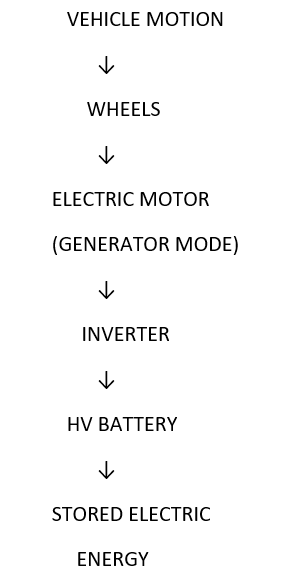
At the same time, the generator’s resistance produces negative torque, which slows the vehicle.
7. Conventional Hydraulic Braking Flow

Modern HEV brake systems can electronically coordinate hydraulic braking, regenerative braking, ABS, and vehicle-stability functions.
8. ABS and Regenerative Braking
During hard braking, wheel-speed sensors continuously monitor wheel rotation.
When the system detects that a wheel is approaching lock-up:
- ABS reduces the appropriate braking force.
- Regenerative braking torque may also be reduced.
- Hydraulic brake pressure is modulated.
- Brake torque is redistributed as necessary.
- Vehicle stability is maintained.
Therefore, regenerative braking is not simply “charging the battery”; it is integrated with the vehicle’s complete brake and stability-control system.
9. Modern HEV Brake Technology
A. Electronic Brake-by-Wire
Modern vehicles increasingly use electronically controlled braking systems.
The brake pedal input is detected electronically, and the system calculates the required braking response.
B. Electromechanical Brake Booster
Modern systems can use an electrically driven brake booster rather than relying entirely on engine vacuum. Bosch, for example, describes an iBooster as a vacuum-independent electromechanical brake booster for regenerative-braking applications.
C. Intelligent Brake Blending
The controller smoothly combines:
Regenerative braking + Hydraulic braking
to provide consistent deceleration and efficient energy recovery.
D. ABS Integration
ABS prevents wheel lock while coordinating with regenerative braking.
E. Electronic Stability Control
The system can coordinate braking torque at individual wheels to help maintain directional stability.
F. Brake Pedal Stroke Simulation
In electronically controlled systems, pedal feel can be generated to provide a familiar braking sensation while the control system manages regenerative and hydraulic braking.
G. Battery-Aware Regeneration
Regenerative braking is automatically adjusted according to:
- Battery state of charge
- Battery temperature
- Motor speed
- Vehicle speed
- Maximum battery charging power
- Driver braking request
- Wheel traction
If the battery is very cold, very hot, or nearly full, regenerative braking may be limited.
10. What Happens During Different Driving Conditions?
| Driving Condition | Regenerative Braking | Friction Braking |
| Accelerator released | High/possible | Usually minimal |
| Gentle braking | High | Low |
| Moderate braking | Moderate–high | Moderate |
| Hard braking | Limited by system capability | High |
| Emergency braking | Reduced/controlled as needed | High |
| Very low vehicle speed | Reduced | Increased |
| Battery nearly full | Limited | Increased |
| Battery too cold/hot | Limited | Increased |
| ABS intervention | Controlled/reduced | Precisely modulated |
The friction brakes are therefore essential as a supplement and safety system; regenerative braking alone cannot provide every required braking condition.
11. Complete HEV Brake System Working Principle
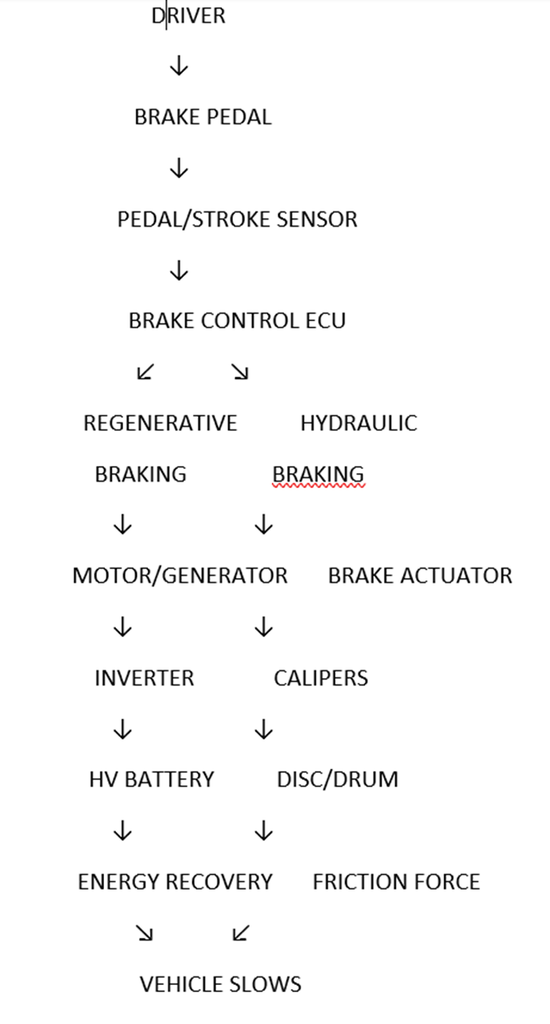
At the same time:
Wheel-Speed Sensors → ABS/ESC → Brake Control ECU
continuously provide feedback for safe braking.
12. Key Advantages of Hybrid Vehicle Brake System
- Recovers braking energy
- Improves overall energy efficiency
- Reduces friction-brake usage
- Reduces brake-pad wear
- Can improve fuel economy
- Provides smooth braking through brake blending
- Works with ABS and stability control
- Reduces energy otherwise lost as brake heat
Research and educational sources describe regenerative braking as recovering some energy that would otherwise be dissipated as heat, then storing it for later use.
In one sentence:
An HEV brake system uses the electric motor as a generator to recover kinetic energy and charge the HV battery, while electronically controlled hydraulic friction brakes provide additional braking force whenever regenerative braking alone is insufficient.