
What is KAIZEN?
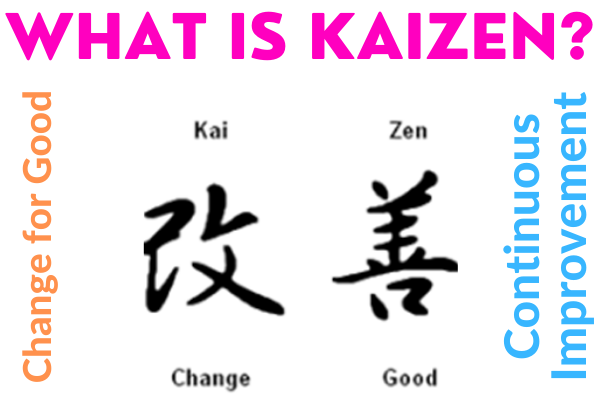
There are two parts of the word KAIZEN. One part is KAI, meaning change in English, and the other part is ZEN, meaning good in English. The origin of this word is Japan. Its simple meaning is “Change for Good” or “Continuous Improvement”. This is the Japanese’s business philosophy regarding the process that continuously improves operations and engages all process-related employees. Its ultimate goal is to increase productivity in a gradual and methodical process.
What are the 5 elements of KAIZEN?
5 Elements are-
- SEIRI
- SEITON
- SEISO
- SEIKETSU
- SHITSUKE
What are the 4 most important rules of it for bottom-up improvement?
The 4 most important rules of KAIZEN are-
- Defects: Don’t pass defective items to the next process.
- Excessive processing: Don’t do excessive processing. Do only what you need.
- Overproduction: Don’t do overproduction. Do only required items.
- Waiting: Don’t keep inactive personnel in the production line.
What are the three pillars of KAIZEN?
The three pillars are-
- 5S
- Standardization
- Eliminate waste
Who should participate?
The following personnel should be involved in KAIZEN–
- Top management
- Senior Leaders
- Departmental leaders
- Team members
- Human Resources superior
- Minutes note writer
How to implement the kaizen philosophy in your workplace?
The following steps can be taken to implement the KAIZEN philosophy–
- Embrace the incremental change
- Seek feedback
- Focus on improving process
- Eliminate waste
- Work as a team to solve the problem.
What is the best practice of KAIZEN?
Best practices of KAIZEN are-
- Set your goal
- Focus on the process, not on the goal
- Engage related employees to develop the process
- Go after the low-hanging fruit
- Do it better, make it better
- Eliminate all kinds of waste
- Think before you invest
- Perform GEMBA
- Hoshin Kanri or policy deployment
What are the 10 principles of KAIZEN to grow your business?
10 principles to grow your business are-
- Welcome new ideas and discard conventional or fixed ones
- Think how to do it, not why it cannot be done
- Don’t make excuses; seek the alternate way to solve the problem
- Correct it right away if you make any mistake
- Don’t seek perfection; just do it right away, and perfection will come to you soon
- Prefer knowledge to spending money to implement it
- Knowledge will be your friend during hardship
- Ask “why” five times to find out the root cause of any problem
- Seek 10 people’s wisdom rather than a single one
- its ideas are a never-ending process
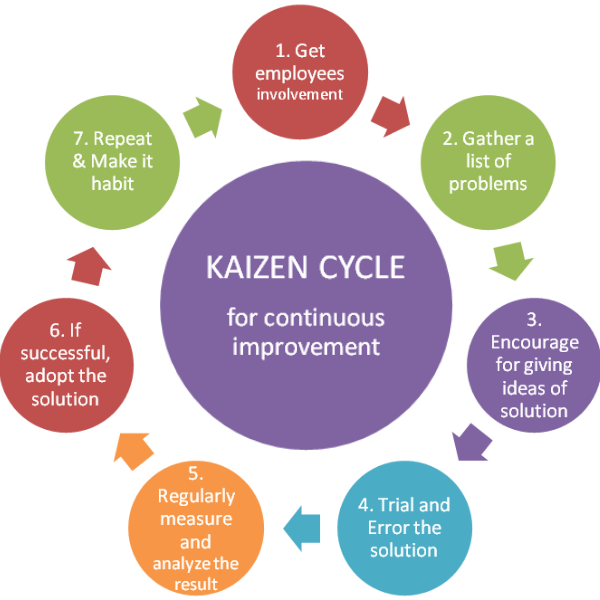
What are the 7 steps of the KAIZEN cycle for continuous improvement?
7 Steps of KAIZEN cycle are-
- Get employees involvement
- Gather a list of problems
- Encourage for giving ideas of solution and select the best one
- Trial and Error the solution
- Regularly measure and analyze the result
- If successful, adopt the solution
- Repeat & make it a habit
What are the business benefits of Kaizen?
Benefits are-
- Improve quality through eliminating defects
- Reducing waste
- Simplifying work processes
- Improve safety
- Increase employee satisfaction
- Customer satisfaction increases
- Increase productivity and efficiency
- Retention rate of employees and customers increases
- Develop teamwork practices
- Improve leadership and ownership