
Introduction
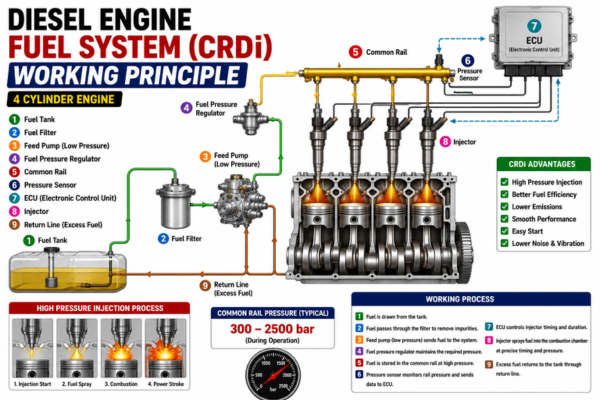
The Common Rail Direct Injection (CRDi) fuel system is one of the most advanced diesel fuel injection technologies used in modern automobiles. It has significantly improved diesel engine performance by increasing fuel efficiency, reducing harmful emissions, minimizing engine noise, and delivering higher power. Today, most passenger cars, SUVs, pickup trucks, buses, and commercial vehicles use CRDi technology because it meets strict emission standards while providing smooth engine operation.
Unlike conventional diesel injection systems, in which each injector has its own pumping mechanism, a CRDi system stores fuel at extremely high pressure in a common rail. This pressurized fuel is then electronically controlled and injected into each cylinder at the exact time and quantity required for efficient combustion.
What is a CRDi Fuel System?
A Common Rail Direct Injection (CRDi) system is an electronically controlled diesel fuel injection system where all injectors receive fuel from a single high-pressure accumulator called the common rail.
The Engine Control Unit (ECU) continuously monitors engine operating conditions using various sensors and controls both fuel pressure and injection timing with high precision.
The operating pressure of a modern CRDi system typically ranges from 1,000 to 2,500 bar (approximately 14,500 to 36,000 psi). Higher fuel pressure produces finer fuel droplets, allowing better mixing with compressed air and resulting in more complete combustion.
Main Components of a CRDi Fuel System
1. Fuel Tank
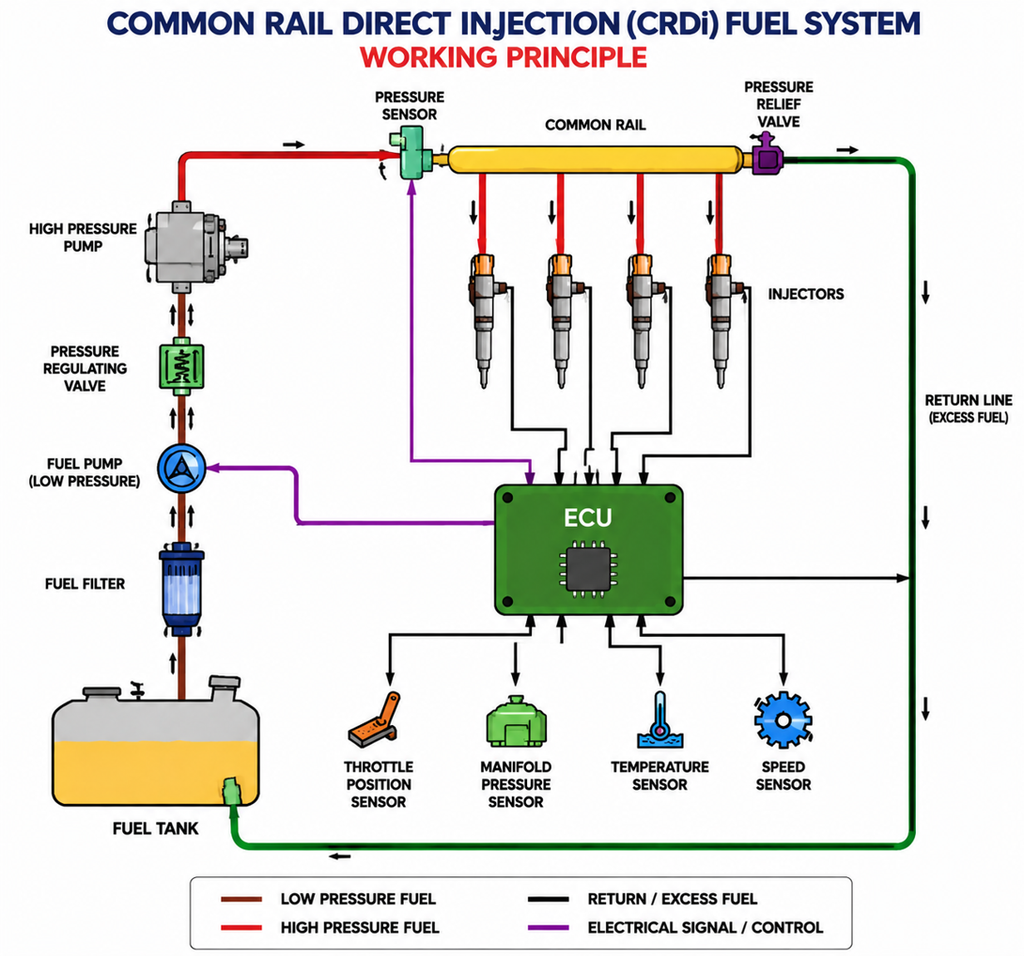
The fuel tank stores clean diesel fuel. It also contains a fuel level sensor and, in many vehicles, an electric lift pump.
Functions
Stores diesel fuel
Supplies fuel to the low-pressure system
Prevents contamination
Allows return fuel to cool
2. Fuel Filter
The fuel filter removes dirt, dust, rust particles, and water before the fuel reaches the high-pressure pump.
Importance
Modern CRDi injectors have extremely small internal clearances. Even microscopic dirt particles can damage the injectors.
Most filters include:
Water separator
Drain valve
Water sensor
3. Fuel Lift Pump
The lift pump transfers diesel fuel from the fuel tank to the high-pressure pump.
It may be:
Electric
Mechanical
Integrated inside the high-pressure pump
4. High-Pressure Fuel Pump
The high-pressure pump compresses diesel fuel to extremely high pressure.
Functions include:
Receiving low-pressure fuel
Compressing fuel
Delivering fuel to the common rail; maintaining pressure under all engine conditions
The ECU controls the fuel quantity entering the pump through a suction control valve.
5. Common Rail
The common rail functions like a high-pressure fuel reservoir.
Functions:
Stores high-pressure fuel
Maintains stable pressure
Supplies fuel equally to all injectors
Reduces pressure fluctuation
Sensors attached include:
Rail Pressure Sensor
Pressure Control Valve
6. Fuel Pressure Sensor
This sensor measures the pressure inside the common rail.
The ECU uses this information to:
Increase pressure
Reduce pressure
Maintain target rail pressure
7. Pressure Control Valve
The pressure control valve regulates rail pressure by returning excess fuel to the return line as needed.
8. Electronic Fuel Injectors
Each cylinder has one electronically controlled injector.
Types include:
Solenoid Injector
Piezoelectric Injector
The ECU opens each injector for only a few milliseconds.
The injector sprays fuel directly into the combustion chamber as a fine mist.
9. ECU (Engine Control Unit)
The functions of the ECU are like the brain of the CRDi system.
It calculates:
Injection timing
Injection quantity
Rail pressure
Pilot injection
Main injection
Post injection
The ECU continuously receives signals from many sensors.
Important Sensors Used in CRDi
The ECU depends on multiple sensors.
These include:
Crankshaft Position Sensor
Camshaft Position Sensor
Accelerator Pedal Position Sensor
Mass Air Flow (MAF) Sensor
Manifold Absolute Pressure (MAP) Sensor
Engine Coolant Temperature Sensor
Fuel Temperature Sensor
Rail Pressure Sensor
Oxygen Sensor (some models)
Exhaust Gas Temperature Sensor
Boost Pressure Sensor
Step-by-Step Working Principle
Step 1: Fuel Storage
Diesel fuel is stored inside the fuel tank.
Step 2: Fuel Supply
The lift pump sends diesel fuel to the fuel filter.
Step 3: Fuel Filtration
The fuel filter removes:
Dust
Rust
Water
Contaminants
Only clean fuel enters the high-pressure pump.
Step 4: High Pressure Generation
The high-pressure pump compresses diesel fuel.
Pressure may exceed 2,000 bar.
Step 5: Fuel Storage in Common Rail
Highly pressurized fuel enters the common rail.
The rail acts like a pressure accumulator.
Step 6: ECU Receives Sensor Signals
The ECU monitors:
Engine speed
Engine load
Accelerator position
Air intake
Engine temperature
Fuel pressure
Within milliseconds, it calculates the ideal injection strategy.
Step 7: Injector Activation
The ECU sends an electrical signal to the injector.
The injector needle lifts.
Fuel sprays into the combustion chamber.
Injection duration is extremely short.
Step 8: Atomization
The injector produces ultra-fine fuel droplets.
Benefits include:
Better mixing with air
Faster combustion
Reduced smoke
Higher efficiency
Step 9: Combustion
The compressed air inside the cylinder reaches approximately 600–800°C during the compression stroke.
When diesel fuel is injected:
Auto-ignition occurs
Combustion starts immediately
Pressure increases rapidly
• The piston moves downward
Mechanical energy is produced.
Step 10: Multiple Injection Events
Modern CRDi systems can perform several injections during one combustion cycle.
Pilot Injection
There is a benefit to injecting a small amount of fuel before the main injection.
Benefits:
Reduces combustion noise
Smooth engine operation
Main Injection
Provides the primary engine power.
Post Injection
Occurs after the main combustion.
Purpose:
Reduces emissions
Increases exhaust temperature
Assists Diesel Particulate Filter (DPF) regeneration
Advantages of CRDi System
Higher fuel efficiency
Increased engine power
Higher torque at low RPM
Lower fuel consumption
Reduced engine noise
Easier cold starting
Lower exhaust smoke
Reduced NOx emissions
Reduced particulate emissions
Better throttle response
Precise fuel control
Longer engine life
Compliance with modern emission standards
Disadvantages of CRDi System
Higher manufacturing cost
Expensive injectors
Expensive high-pressure pump
Requires specialized diagnostic tools
Sensitive to contaminated fuel
Costly repairs
Requires high-quality diesel fuel
Common CRDi System Problems
Hard starting
Engine misfire
Excessive black smoke
White smoke
Low engine power
Poor fuel economy
Rough idle
Engine knocking
Injector leakage
Rail pressure too low
Rail pressure too high
Fuel contamination
Water in diesel
High-pressure pump wear
Injector clogging
Air entering the fuel system
Fuel filter blockage
Maintenance Tips
Replace the fuel filter at the recommended service interval.
Use clean, high-quality diesel fuel from trusted suppliers.
Drain water from the fuel filter or water separator when required.
Avoid running the fuel tank empty to reduce the risk of air entering the system.
Keep the fuel tank clean to prevent contamination.
Check for leaks in fuel lines, pipes, and injector connections.
Use diagnostic equipment to monitor rail pressure and injector performance.
Replace worn injectors or pumps with genuine or high-quality parts.
Follow the manufacturer’s maintenance schedule.
Never disconnect high-pressure fuel lines while the engine is running.
Safety Precautions
CRDi systems operate at extremely high pressure. Fuel escaping from a damaged line or injector can penetrate the skin and cause serious injury.
Always:
- Switch off the engine before servicing.
- Release fuel pressure according to the manufacturer’s procedure.
- Wear safety glasses and protective gloves.
- Never place your hand near a suspected high-pressure fuel leak.
- Keep the work area clean to avoid contamination.
- Dispose of spilled diesel fuel responsibly.
Conclusion
The Common Rail Direct Injection (CRDi) fuel system has transformed modern diesel engine technology by combining high-pressure fuel delivery with precise electronic control. Its ability to inject fuel accurately at the optimal pressure and timing results in improved combustion, greater power, lower fuel consumption, quieter operation, and reduced emissions. Although the system requires clean fuel, specialized diagnostic equipment, and careful maintenance, its advantages make it the preferred diesel fuel injection technology for today’s vehicles. Understanding the components, operating sequence, and maintenance practices of a CRDi system is essential for automotive technicians, workshop professionals, and engineering students seeking to diagnose, service, and optimize modern diesel engines effectively.