
Introduction to the Modern Gasoline Engine
A modern gasoline engine is an internal combustion engine (ICE) that converts the chemical energy stored in gasoline into mechanical energy to propel a vehicle. It is one of the most widely used power sources in passenger cars, light trucks, motorcycles, and small machinery. Modern gasoline engines have evolved significantly over the years, incorporating advanced technologies such as electronic fuel injection, engine control units (ECUs), variable valve timing, turbocharging, and direct injection systems to improve performance, fuel economy, and emissions control.
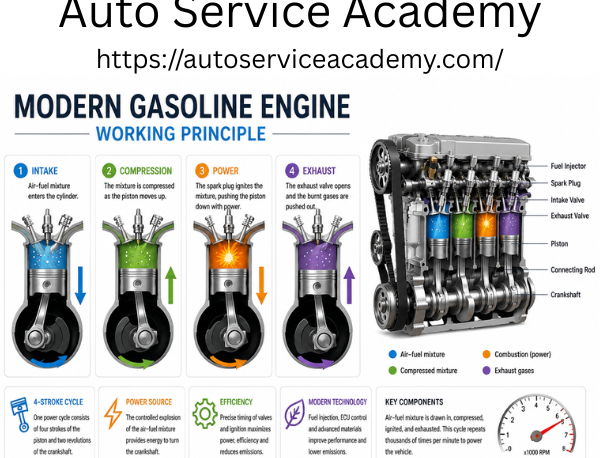
The basic working principle of a gasoline engine is based on the four-stroke combustion cycle, commonly known as the Otto Cycle. This cycle consists of four distinct strokes of the piston: Intake, Compression, Power (Combustion), and Exhaust. These strokes occur continuously and repeatedly while the engine is running.
Main Components of a Modern Gasoline Engine
Before understanding the working principle, it is important to know the major components involved in engine operation:
1. Cylinder Block
The cylinder block forms the main structure of the engine and houses the cylinders where combustion occurs.
2. Piston
The piston moves up and down inside the cylinder and transfers combustion force to the crankshaft.
3. Connecting Rod
The connecting rod links the piston to the crankshaft and converts reciprocating motion into rotational motion.
4. Crankshaft
The crankshaft converts the piston’s up-and-down movement into rotational force that drives the vehicle.
5. Intake Valve
Allows the air-fuel mixture to enter the combustion chamber.
6. Exhaust Valve
Allows burnt gases to leave the combustion chamber.
7. Spark Plug
Produces a spark that ignites the compressed air-fuel mixture.
8. Fuel Injector
Sprays fuel into the intake port or directly into the combustion chamber.
9. Camshaft
Controls the opening and closing of intake and exhaust valves.
10. Engine Control Unit (ECU)
The ECU is the electronic brain of the engine, monitoring sensors and controlling fuel injection, ignition timing, and other engine functions.
The Four-Stroke Working Principle
A modern gasoline engine operates through a sequence of four piston strokes. One complete cycle requires two revolutions of the crankshaft (720 degrees).
1. Intake Stroke
Process
The cycle begins with the intake stroke. During this stroke:
- The piston moves downward from Top Dead Center (TDC) to Bottom Dead Center (BDC).
- The intake valve opens.
- The exhaust valve remains closed.
- Air enters the cylinder through the intake manifold.
- Fuel is mixed with air either in the intake port or directly inside the cylinder.
Purpose
The objective of the intake stroke is to fill the cylinder with the correct amount of air-fuel mixture for efficient combustion.
Modern Technology
Modern engines use:
- Electronic Fuel Injection (EFI)
- Mass Air Flow (MAF) sensors
- Manifold Absolute Pressure (MAP) sensors
- Variable Valve Timing (VVT)
These systems optimize the amount of air and fuel entering the engine.
2. Compression Stroke
Process
After the cylinder is filled:
- Both intake and exhaust valves close.
- The piston moves upward from BDC to TDC.
- The air-fuel mixture is compressed into a small space.
Purpose
Compression increases:
- Mixture temperature
- Mixture density
- Combustion efficiency
The compressed mixture becomes highly combustible and ready for ignition.
Compression Ratio
Modern gasoline engines typically have compression ratios ranging from:
- 9:1 to 14:1
Higher compression ratios improve fuel efficiency and power output.
Importance
Proper compression is essential because it:
- Increases engine efficiency
- Improves fuel economy
- Produces more power from the same amount of fuel
3. Power Stroke (Combustion Stroke)
Process
Near the end of the compression stroke:
- The spark plug generates a high-voltage spark.
- The compressed air-fuel mixture ignites.
- Rapid combustion creates high-pressure gases.
- These expanding gases force the piston downward.
Energy Conversion
This is the only stroke that produces useful power.
The process converts:
Chemical Energy → Thermal Energy → Mechanical Energy
Crankshaft Rotation
As the piston moves downward:
- The connecting rod transfers force to the crankshaft.
- The crankshaft rotates.
- Rotational energy is transmitted to the transmission and wheels.
Importance
The power stroke determines:
- Engine power
- Vehicle acceleration
- Torque output
Modern ECUs precisely control ignition timing to maximize power and reduce fuel consumption.
4. Exhaust Stroke
Process
After combustion:
- The exhaust valve opens.
- The intake valve remains closed.
- The piston moves upward from BDC to TDC.
- Burnt gases are pushed out through the exhaust system.
Purpose
The exhaust stroke removes combustion by-products from the cylinder, preparing it for the next cycle.
Exhaust System Components
Modern vehicles use:
- Exhaust manifold
- Catalytic converter
- Oxygen sensors
- Muffler
- Tailpipe
These components reduce harmful emissions and noise.
Continuous Engine Operation
The four strokes occur continuously in sequence:
- Intake
- Compression
- Power
- Exhaust
In a four-cylinder engine, each cylinder operates at a different stage of the cycle. This arrangement ensures smooth power delivery and reduced vibration.
For example:
| Cylinder | Current Stroke |
| Cylinder 1 | Power |
| Cylinder 2 | Compression |
| Cylinder 3 | Exhaust |
| Cylinder 4 | Intake |
This coordinated operation allows the engine to run smoothly and efficiently.
Fuel Injection System
Modern gasoline engines primarily use electronic fuel injection systems.
Types of Fuel Injection
Port Fuel Injection (PFI)
Fuel is sprayed into the intake port before entering the cylinder.
Gasoline Direct Injection (GDI)
Fuel is injected directly into the combustion chamber.
Advantages
- Better fuel economy
- Improved performance
- Reduced emissions
- Faster engine response
The ECU calculates the exact fuel quantity required under all operating conditions.
Ignition System
The ignition system is responsible for initiating combustion.
Components
- Battery
- Ignition coils
- Spark plugs
- ECU
Working
The ignition coil increases battery voltage from 12 volts to approximately 20,000–40,000 volts.
This high voltage creates a spark across the spark plug electrodes, igniting the compressed air-fuel mixture.
Benefits of Modern Ignition Systems
- More precise timing
- Better fuel economy
- Improved engine performance
- Reduced emissions
Engine Lubrication System
The lubrication system reduces friction between moving components.
Main Components
- Engine oil
- Oil pump
- Oil filter
- Oil passages
Functions
- Reduce wear
- Prevent overheating
- Clean engine components
- Extend engine life
Modern gasoline engines rely heavily on proper lubrication for long-term reliability.
Engine Cooling System
Combustion generates temperatures exceeding 2,000°C inside the combustion chamber.
The cooling system prevents overheating.
Components
- Radiator
- Water pump
- Thermostat
- Coolant
- Cooling fan
Functions
- Maintain optimal temperature
- Prevent engine damage
- Improve efficiency
- Reduce emissions
Most gasoline engines operate efficiently between 85°C and 105°C.
Electronic Engine Management
Sophisticated ECUs control modern gasoline engines.
Sensors Used
- Oxygen sensor
- Crankshaft position sensor
- Camshaft position sensor
- Coolant temperature sensor
- Knock sensor
- Throttle position sensor
- MAF sensor
- MAP sensor
ECU Functions
- Fuel injection control
- Ignition timing control
- Emission management
- Idle speed control
- Diagnostic monitoring
The ECU continuously adjusts engine operation to achieve maximum efficiency and minimum emissions.
Modern Technologies in Gasoline Engines
Variable Valve Timing (VVT)
Adjusts valve opening and closing timing according to engine speed and load.
Benefits
- Increased power
- Better fuel economy
- Reduced emissions
Turbocharging
A turbocharger uses exhaust gases to force additional air into the engine.
Benefits
- Higher power output
- Improved efficiency
- Smaller engine size with greater performance
Start-Stop Technology
Automatically shuts off the engine when the vehicle is stationary and restarts it when needed.
Benefits
- Reduced fuel consumption
- Lower emissions
Direct Injection
Injects fuel directly into the combustion chamber at high pressure.
Benefits
- Better combustion
- Higher efficiency
- Increased power
Advantages of Modern Gasoline Engines
High Performance
Gasoline engines provide excellent acceleration and smooth operation.
Low Noise
They operate more quietly than many diesel engines.
Fast Response
Quick throttle response improves driving comfort.
Reduced Emissions
Advanced emission control systems significantly reduce pollutants.
Reliability
Modern engine management systems improve durability and dependability.
Conclusion
The modern gasoline engine is a highly refined machine that converts fuel energy into mechanical power through the four-stroke cycle of intake, compression, power, and exhaust. Advanced technologies such as electronic fuel injection, direct injection, ECU control, variable valve timing, turbocharging, and sophisticated emission systems have greatly improved engine efficiency, performance, and environmental friendliness. Despite the growth of electric vehicles, modern gasoline engines remain an important and effective source of transportation power due to their reliability, performance, and continuous technological advancements.